Fusion for Energy (F4E) and Safran Electronics & Defense joined their expertise and know-how to fine-tune a fully digital LLRF system aligned with ALBA Synchrotron technical specifications and firmware in Barcelona.
Particle accelerators, just like fusion devices, are pushing the frontiers of both physics and technology. Building them calls for innovative suppliers capable of engineering solutions for extremely complex requirements. The synergies between these fields are clear, and the know-how developed in one Big Science project often finds its way into another.
That’s the case with the LIPAc accelerator prototype project. Built and operated by Europe and Japan, LIPAc aims to validate the technologies for future fusion-relevant neutron sources such as IFMIF-DONES in Spain and A-FNS in Japan -two advanced irradiation facilities that will test materials for fusion.
To accelerate particles, systems like LIPAc use powerful radiofrequency fields. These waves must be continuously “tuned” to maintain a stable and precise beam. For this purpose, Safran developed a Fully Digital Low-Level Radio Frequency (LLRF) Controller, designed to operate reliably under LIPAc’s strict performance, stability and integration constraints.
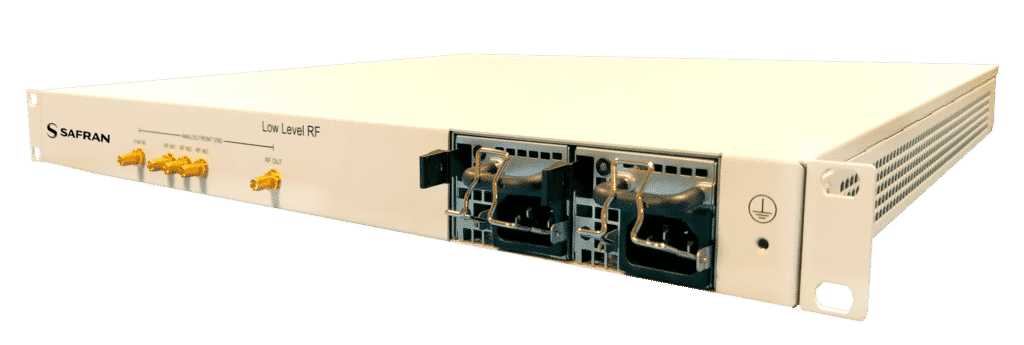
Unlike older, partly analogue systems, this solution processes signals digitally, offering an efficient and high-precision tool to control the accelerator more easily in real time,” explains Hervé Dzitko, IFMIF/EVEDA Project Leader.
Over time, the controller evolved into a versatile platform, ready to meet the demanding specifications of large scientific infrastructures. ALBA Synchrotron, a leading European research facility near Barcelona, was the first to benefit from it.
While the equipment and implementation for ALBA are not identical to LIPAc and the systems are different, the know-how and experience gained during the LIPAc development have clearly been valuable and served as a strong basis for supporting subsequent applications such as the ALBA upgrade.
Indeed, for a synchrotron (a ring-shaped accelerator), RF stability is critical to keep electron beams tightly controlled and produce X-ray light for experiments. ALBA’s RF team was looking for a next-generation digital controller solution to replace its obsolete digital system from the 2000s, for both the booster and the storage ring, with higher accuracy and long-term stability, as well as enhanced maintainability.
Safran Electronics & Defense met these needs thanks to the flexibility and performance of the controller’s digital architecture developed within the framework of the LIPAc project. The system was adapted to ALBA’s operational specifics, enabling easy integration of ALBA’s LLRF firmware and seamless implementation into the accelerator’s control ecosystem.
The performance of Safran’s digital controller has met our strict requirements, improving the precision of RF voltage amplitude and phase control and allowing faster reactions to perturbations, thus improving beam stability. We also expect better reliability than with our previous digital system,” commented Francis Perez, Accelerator Division Head at ALBA Synchrotron.
From LIPAc to ALBA, Safran’s technology has proven its potential in different high-performance environments. This marks yet another successful technology transfer story for F4E.
Learn more:
See more about the LLRF controller in our technology portfolio
Digital Low-Level RF (LLRF) System Upgrade for the ALBA Synchrotron – Safran – Navigation & Timing