Within the framework of fusion technology research and development, a neutron source has long been considered a key facility to perform irradiation tests aiming at populating materials engineering database. In this context, the Italian National Agency for New Technologies, Energy and Sustainable Economic Development (ENEA) designed in the 1990s in Frascati a new neutron source called Sorgentina to test structural materials of thermonuclear fusion reactors. This fusion expertise has been harnessed to establish a groundbreaking scientific hub dedicated to the creation of radiopharmaceuticals (with a specific focus on advancing cancer diagnosis and treatment) and Sorgentina has since evolved into a potential game-changer for medical applications.
In 2016, ENEA researchers identified a remarkable capability within Sorgentina: the potential to generate 99Mo from natural Molybdenum. This discovery carries immense significance, as 99Mo serves as a critical component for producing 99mTc, a widely employed radiotracer in medical imaging procedures such as SPECT (single photon emission computed tomography), owing to its brief half-life and emission of low-energy gamma rays. The world encountered a shortage of 99mTc in 2009 due to reactor shutdowns namely NRU in Canada and HFR in the Netherlands), unmasking vulnerabilities in the supply chain. In response, ENEA put forth a groundbreaking solution – harnessing the power of irradiated natural Molybdenum. This strategic move not only addressed the supply chain concerns but also bolstered the safety and efficiency of the SORGENTINA design.
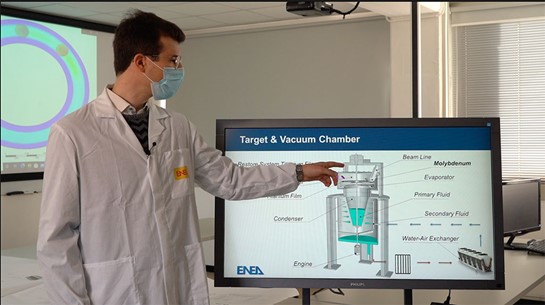
To materialise this visionary approach, ENEA embarked on a series of enhancements to its Sorgentina RF facility. The goal was clear: demonstrate the feasibility of producing 99Mo utilising a 14 MeV neutron source. This technique leverages a D-T fusion source to bombard a molybdenum target, a methodology previously proven effective at ENEA’s Frascati Research center. This ambitious endeavor employs a linear accelerator to deliver deuterium/tritium ions on a rotating target, giving rise to fusion reactions that prodiuce neutrons used to irradiate molybdenum and facilitate the production of 99Mo. Consequently, Sorgentina RF metamorphosed into an exemplar of radiopharmaceutical production through fusion neutronsfor medical diagnostic investigations (neoplasms, cardiac disorders, and neurological diseases).
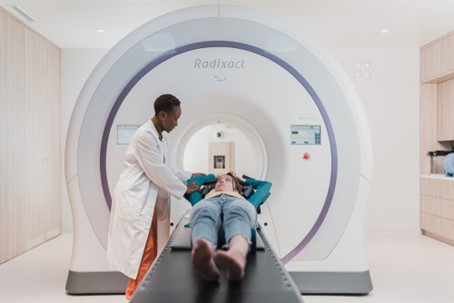
ENEA’s demonstrations at the Frascati and Casaccia Centers underscored the practicality and purity of the production process. These milestones served as the stepping stones for the establishment of a dedicated production center, poised to fulfill 99Mo requirements for a (let say 20% of the Italian population). Beyond addressing immediate needs, this pioneering initiative also fuels the exploration of novel radiopharmaceuticals and material behaviors, cementing ENEA’s position at the forefront of fusion-driven medical advancements.